
- It is recommended to line the bottom of your green organics cart with newspaper, paper towel, or an approved 100 per cent compostable bag to ensure items don't stick to the bottom.
- If desired, you may also place organic waste in paper bags and dispose of the paper bags in your organic cart.
- Layer wet items with dry ones.
- If possible, wait until the day before collection day to clear your fridge of food you're disposing of.
- To help reduce odours, wrap meat and seafood in newspaper.
- Cart contents must not exceed 100 kilograms (220 lbs).
Organics & Composting
The Curbside Organics Program launched May 6, 2024, for all houses and semi-detached houses within the City of Wetaskiwin. Thanks to this program, your household organic waste can be turned into compost instead of going to the landfill. Add food scraps, yard waste, soiled pizza boxes and more!
When does the City pick up organic waste?
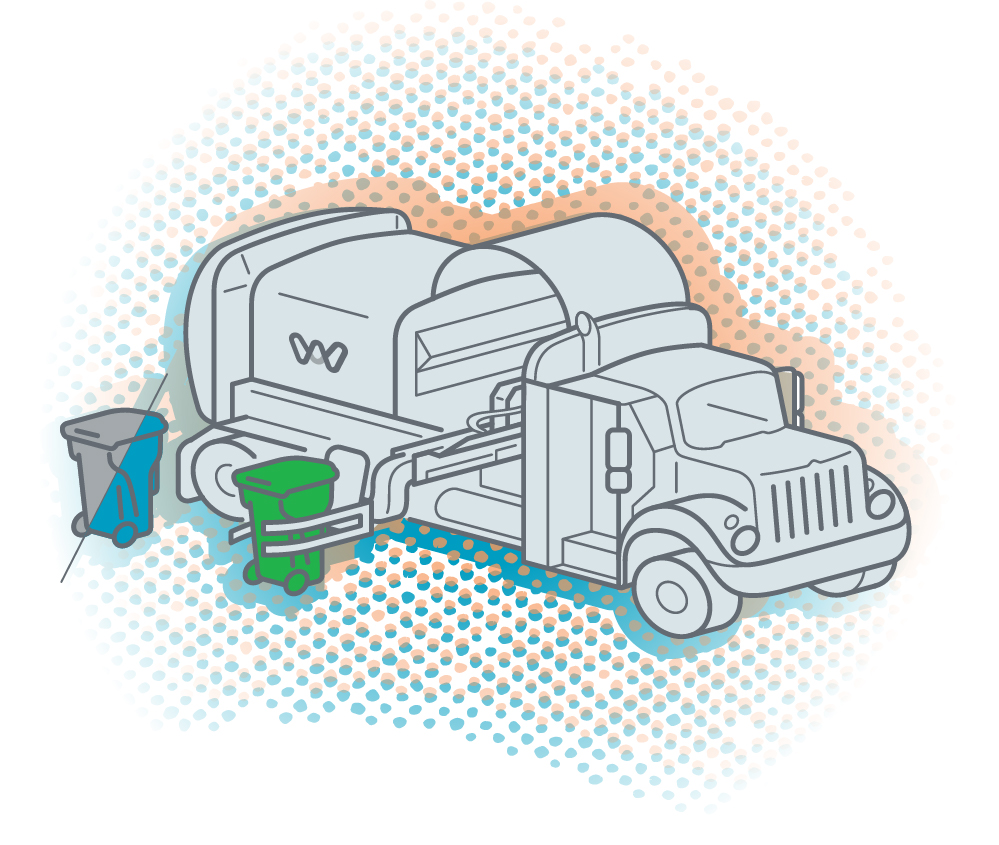
Green carts are collected on the same day as your garbage collection. Click here to download a handy collection map showing specific pickup days and zones.
Place your green cart (along with your blue or grey carts) out for collection by 7 a.m. on your collection day. Curbside collection uses different trucks for each type of material, and will come by at different times throughout the day.
Collection should be complete by 7 p.m. Remember to pull your carts back to their storage spot at the end of the day.
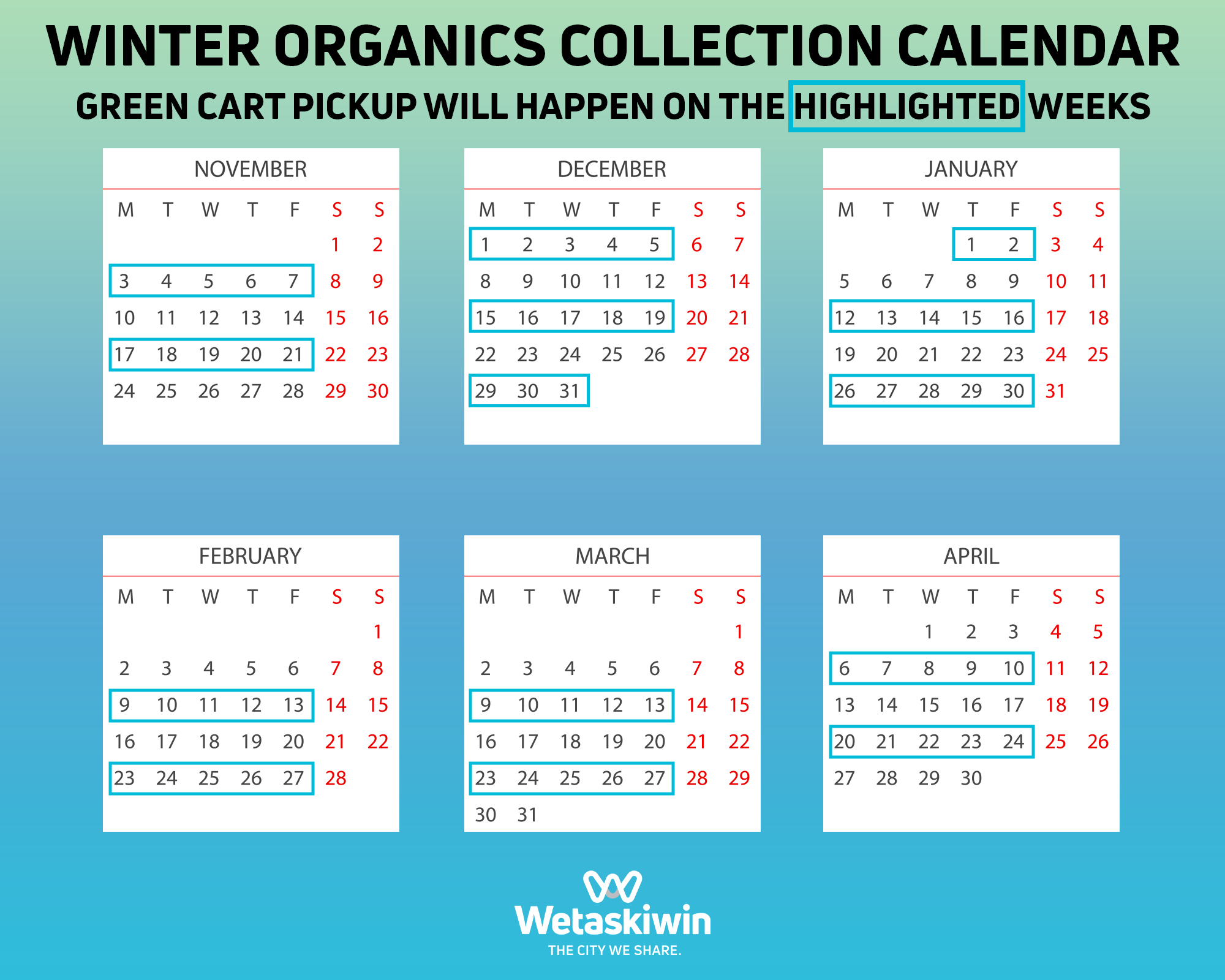
Note: Green carts will be collected weekly from May to October and bi-weekly from November to April. For the 2025–2026 Winter Organics Collection Calendar, click here.
What goes into your green cart?
Organic waste materials are classified as food waste, yard waste, approved paper products (including food-soiled paper products) and pet waste. These items are composed of natural materials and thus can be broken down into compost. When in doubt, use this general rule of thumb: if a household waste item came from something that was once living, it probably belongs in your green cart.
| Acceptable items | Details |
| All food scraps |
Egg shells and dairy |
| Food-soiled paper products |
Paper plates and pizza boxes |
| Pet waste |
Only permitted in compostable bags |
| Yard waste |
Leaves, twigs, and branches |

Unacceptable items
- NO food in packaging.
- Separate food scraps from containers before composting.
- NO plastic bags of any kind.
- NO plant pots or bedding trays.
- Always separate plants and soil from the container before composting.
- NO diapers or wipes.
- Even if they say compostable on the label, please keep them out of your green cart!
- NO foam, plastics, coffee cups, stickers, or labels.
- NO garbage in the organic cart.
Curbside Organics FAQs
Why compost? What are the benefits of the green cart?
Waste diversion is a community issue so it takes a community to find a solution!
Based on waste audits at the Wetaskiwin Sanitary Landfill, more than half of what we throw into waste carts is organic material and can go into the green carts. The introduction of the green cart program means the organics material can be diverted from landfill and help meet our waste diversion targets.
A green cart program will also prolong the life of our landfill, help reduce landfill greenhouse gasses and leachate emissions which contribute to climate change. It also provides another option for residential food waste management.
On what day and how often will my green cart be collected?
The green cart will be collected weekly from May to October and bi-weekly from November to April. Green cart collection will take place on the same day as your blue or grey (waste) carts.
How do I make sure my green cart is collected?
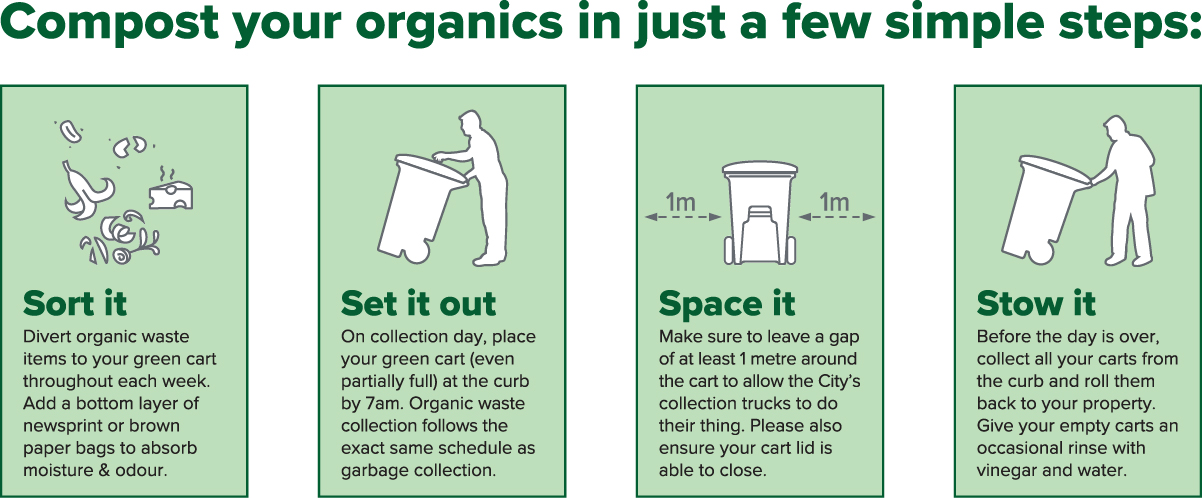
- Kitchen catchers — Each household will be provided a kitchen catcher with their green cart. The kitchen catcher can be used on your countertop, under your sink, or wherever is most convenient for you to collect your kitchen waste. Simply collect organic materials generated in your home in the kitchen catcher and empty it into the green cart when full.
- Bagging materials — Organic materials can be placed loosely in your cart, in regular paper bags, compostable bags, or even in larger paper yard waste bags. Plastic bags will not be accepted in this program. Remember not to overfill your green cart, the lid must close.
What is the weight limit of the green cart?
Your green cart contents must not exceed 100 kilograms (220 lbs). If you can easily roll the cart, it should be okay for collection. If the cart is too heavy, please remove materials from it until it is easy to roll and return the materials to the cart after it is emptied.
There is no opt out of the curbside organics program.
Waste diversion is a community issue — so it takes a community to find a solution! Like many other municipalities, to plan and operate the program efficiently, it needs to be universally implemented across the entire community.
There is no additional cost for the organics collection service for 2024. Service costs are reviewed annually, and there is an inflationary increase as part of the contract. The kitchen catchers and green carts for this program were purchased using money the City saved by switching to Environmental 360 Solutions Ltd. (E360S) for waste collection services in 2023.
What if I already use a backyard composter?
We encourage you to continue your backyard composter. Waste diversion is a community issue so it takes a community to find a solution!
If you already have a backyard composter, feel free to keep using it and use your green cart for all the items you can't place in your composter such as meat, fish, shellfish, bones, dairy products, cooked food, cooking grease and oils, fast food packaging, paper plates, napkins, and soiled pizza boxes (just to name a few). In addition, backyard composters have a limited capacity and the processing time limits the amount of material that can be diverted.
Backyard composting can become dormant in winter months and may not allow the materials to decompose. The green cart program allows for year-round collection of organic material.
I have a garburator; why do I need a green cart?
The green cart is a more efficient way to dispose of organic waste than your garburator.
You're able to dispose of things like meat, bones, paper towel, and soiled food boxes. Much more than you can fit or should put down your sink and send to the Wetaskiwin Wastewater Treatment Plant for processing.
Plus, when you send oils, grease and fats down your sink, this can result in blockages or 'fatburgs' in the sewer system.
Garburators also use lots of water, which you'll see as a cost on your utility bill. Sending solid waste down your sink may also lead to potential plumbing problems down the road.
Apartments and condominiums are currently not included in the City’s organics collection.
Which weeds and plants are not allowed in my green cart?
Diseased branches, noxious weeds, and elm wood are not accepted in the Curbside Organics Program. Instead, please bag, tie up, and place these materials in your waste cart. A list of provincially regulated weeds is available on the Government of Alberta website.
Branches larger than five (5) centimetres in diameter and one (1) metre in length are also not allowed in the green cart. These should be broken down into smaller pieces before placing them in your green cart.
How do I keep my cart clean to prevent odours and pests?
- If you can, store your green cart outside in a shady spot on your property.
- Use odour absorbers or neutralizers. Sprinkle baking soda, use a few drops of essential oils, or spray air freshener into your organic waste.
- Freeze or refrigerate your organic waste and throw it into your green cart the night before collection day.
- Rinse your cart on your property with a hose and pour the water onto your grass, gravel, or garden. Do not pour dirty water onto the street, down the storm drain, or onto other properties.
How do I prevent organics from freezing inside my cart during the cold months?
In the colder months, wet organic material can freeze to the inside of your green cart. Follow these tips to prevent material from sticking inside the cart:
- Put crumpled flyers, newspaper, paper bags, or soiled pizza boxes in the bottom of your green cart before putting in any food or yard waste.
- Alternate between layers of food/yard waste and paper products.
- Store wet kitchen scraps in paper liners. Use a broom handle or a long stick to dislodge frozen material from the bottom or sides of your cart.
- Keep your organics in a paper bag in the freezer and deposit the bag into your cart before collection day.
- If possible, store your cart in sunlight during the colder months.
My kitchen catcher broke! Can the City give me a new one?
The City provided each household with one 8-litre kitchen catcher at the start of the program. Kitchen catchers are available for purchase through most big-box stores or by calling the Operations Facility at 780.361.4436.
What if I don’t follow the rules?
If you happen to put something in your green cart that should have been left out, our Waste team may leave you an "oops tag" that will give you information on what you did wrong. On the following pickup date, your cart will be inspected again. If there is still material that is not acceptable, the cart will not be picked up that week.
Organics are classified as food waste, yard waste, approved paper products (including food-soiled paper products), and pet waste. These get categorized as items that are made of natural materials and can be broken down into compost. A good general rule of thumb is: if the material came from something that was once living, it can probably go in your green cart.
How come my organic cart wasn't collected?
Green cart inspections happen regularly, and if your cart wasn’t collected, it likely means that an inspection found your cart to be contaminated — meaning that it contained non-compostable waste or recyclable material, which can contaminate an entire truckload of organics, resulting in all of it being landfilled rather than repurposed into valuable compost.
Contact Us
City of Wetaskiwin
Operations Facility
5520 50 Street
Wetaskiwin
Alberta, Canada T9A 2G9
Phone: 780.361.4436
Email: waste@wetaskiwin.ca